
Before Temporal Stabilization
Frame-by-frame Geo-Stitch result before temporal–spatial stabilization. Notice the visible frame-to-frame shaking caused by repeated transformation estimation.
ONGOING RESEARCH & DEVELOPMENT PROJECT
A living research journey in lightweight multi-camera image and video stitching.
We are developing a lightweight multi-camera system that transforms overlapping video streams into a coherent, stable and immersive panoramic view.
Imagine experiencing a sporting event beyond the limits of a single camera — following the action through a wider and more coherent visual perspective, as if you were standing closer to the scene.
From our first image-stitching experiments to the current integration of temporal stabilization and dynamic-object awareness, this website documents what we have built, what we have learned, and what remains to be solved.

Current development stage
Dynamic-object-aware video stitching
The panorama is becoming temporally stable, while object detection and tracking are being integrated to guide the seam around people and moving objects.
Project status
The project has already moved through several major stages. We first established its geometric foundations through two image-stitching approaches: SENA and Geo-Stitch. These methods allowed us to study structural preservation, parallax management, controlled warping and artifact prevention.
We then extended Geo-Stitch to continuous video streams. This transition revealed a new challenge: even when individual stitched frames appear acceptable, small variations between consecutive transformations can produce visible shaking and temporal instability.
A temporal–spatial stabilization module has now been introduced to reduce these fluctuations. With the global panorama becoming more stable, current work focuses on preserving people and moving objects when the stitching seam crosses a dynamic scene.
Why we build it
Our long-term vision is to allow spectators to experience sporting events through a wider and more immersive visual perspective. Instead of relying on a single fixed viewpoint, the system combines several partially overlapping camera streams into one coherent panorama.
The viewer can therefore observe more of the scene while preserving the spatial relationships between players, objects and their environment. The final experience is intended for both live viewing and replay.
To make this possible, the system must solve several challenges at once: camera acquisition, stream transmission, frame synchronization, geometric alignment, parallax management, temporal stability, dynamic-object preservation and efficient processing on constrained hardware.
A successful output must remain geometrically coherent, temporally stable, visually continuous across the seam and efficient enough to support the project's long-term live-processing objective.
Architecture
Turning multiple camera views into a single panoramic video requires more than placing images side by side. The system must acquire the streams, synchronize the incoming frames, identify reliable geometric correspondences, align the overlapping regions, stabilize transformations over time and determine how both views should be combined.

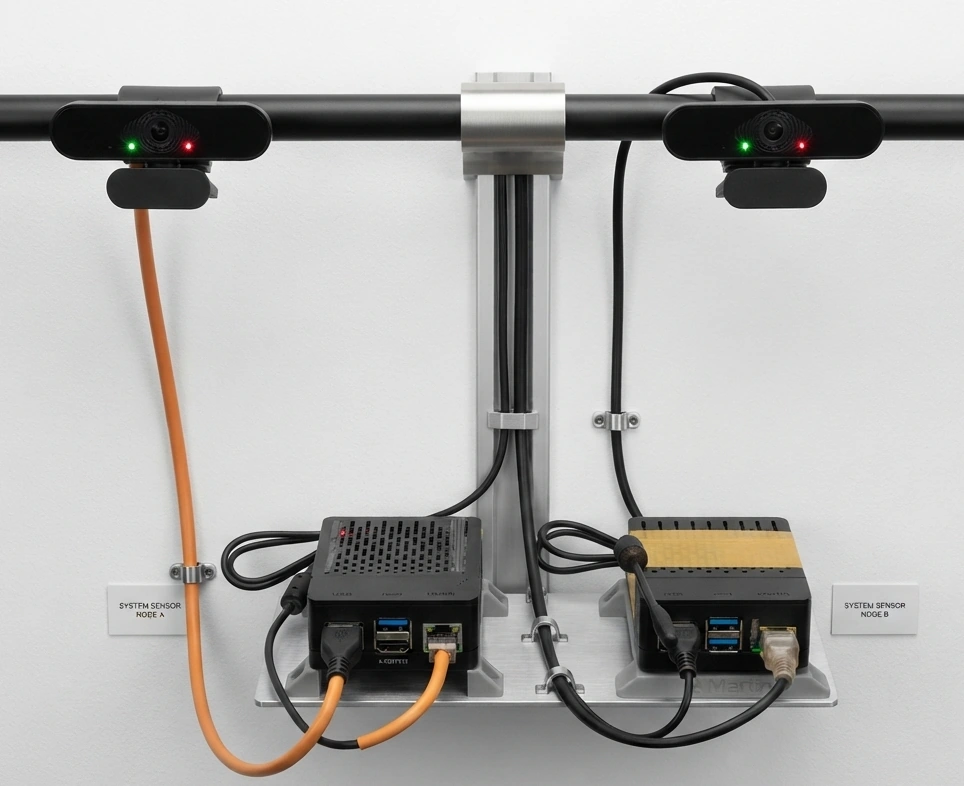
The diagram presents the complete path from distributed scene acquisition to panoramic output. Each camera is connected to an IPU, which acquires and transmits the streams. The streams are centralized, processed together, and transformed into a resulting panorama.
Two cameras observe different but partially overlapping portions of the same scene. The common area provides the information required to estimate their geometric relationship.
The Internal Processing Unit captures and transmits video streams to the central processing node.
Corresponding frames are collected and prepared for synchronization and joint processing.
Reliable correspondences guide global alignment, local refinement and controlled deformation.
Current transformations are combined with information from previous frames to reduce sudden frame-to-frame fluctuations.
The system selects a suitable transition between both views and blends them into a continuous frame.
The resulting panoramic frames form a coherent sequence intended for immersive live or replay-based viewing.
The acquisition, transmission and geometric-stitching components form the current foundation. Temporal stabilization has already been added. The current development stage feeds dynamic-scene information back into the stitching pipeline so that future seam decisions can better preserve people and moving objects.
Timeline
The final panoramic video is the result of several interconnected research stages. Each milestone solved one part of the problem while revealing the next challenge. The journey began with static images, progressed toward wide-parallax artifact prevention and has now reached temporally stable video stitching in dynamic scenes.
STRUCTURE PRESERVATION AND EFFICIENCY
The first major milestone was SENA, a geometry-driven image-stitching approach designed to reduce the structural distortions commonly produced by homography-based pipelines.
Conventional homographies rely on a planar-scene assumption. In scenes containing depth variation, that assumption can produce bulging, excessive warping, altered proportions and broken structures. SENA was developed to overcome these limitations through three complementary mechanisms.
A strategy combining global affine initialization, local affine refinement and a smooth free-form deformation field regulated by SeamGuard adaptive smoothing.
A geometry-driven mechanism for detecting adequate zones — regions with reduced parallax — from the disparity consistency of RANSAC-filtered correspondences, without relying on semantic segmentation or depth estimation.
An anchor-based seamline cutting and segmentation process inside those zones, enforcing one-to-one geometric correspondence and reducing ghosting and smearing.

The pipeline begins with two overlapping images and an initial geometric relationship. It then identifies the part of the overlap where correspondences are sufficiently consistent, limits the stitching operation to this adequate zone and constructs a controlled seam. The final stage combines the selected content into a more natural panorama with reduced structural distortion.
SENA demonstrated improved structural fidelity, visual realism and computational efficiency across diverse scenes. Affine transformations were selected deliberately to reduce running time, because the long-term objective requires a lightweight algorithm capable of producing useful results even on CPU-based systems.


The approach can become less effective under extreme viewpoints or severely texture-deprived regions. More importantly, affine transformations provide only six degrees of freedom. As parallax becomes more pronounced, this limited flexibility can be insufficient for the stronger deformation required by difficult scenes. This limitation motivated the next stage of the project.
SENA source code on GitHubPrevention over correction
Geo-Stitch introduced a different philosophy: prevent artifacts rather than correct them after they have already been created.
Many parallax-tolerant methods warp the entire image domain or overlap area and then depend on correction algorithms to remove residual artifacts. Even methods that restrict alignment to stable regions may use criteria that do not directly measure depth-induced geometric inconsistencies caused by camera translation.
Geo-Stitch reformulates wide-parallax alignment as a projection-reliability problem in the panorama domain. At its core is a warp support field: an explicit pixel-level measure of inverse-projection stability. Projection feasibility, boundary instability and constraint support are jointly used to derive a geometrically valid domain that bounds local deformation and seam placement.
Global warp selection, spatially adaptive warping and blending are governed by this reliability field. Geometric consistency is therefore enforced by construction instead of being recovered through post-hoc correction.
Core idea
Do not create an artifact and then attempt to remove it. Restrict alignment, deformation and seam placement so that unstable geometry is excluded from the process from the beginning.

The diagram is organized into three connected stages:
The system estimates the global relationship between the two images and selects the more reliable warping direction.
Local deformation is applied according to the spatial support available in the panorama domain. Weakly supported or unstable regions are prevented from receiving uncontrolled deformation.
The final seam and blending operation remain within geometrically valid regions, reducing visible discontinuities and preventing unreliable areas from contaminating the final panorama.
Representative wide-parallax results are shown below. The publication link will be added as soon as the article becomes available.

ACTIVE DEVELOPMENT
Research question
How can two synchronized, partially overlapping video streams be transformed into a geometrically coherent and temporally stable panoramic video while visible stitching artifacts are kept to a minimum?
The ultimate objective has always been video stitching. Image stitching established a solid geometric foundation, but moving to continuous video introduces a temporal dimension that exposes limitations that can remain hidden or tolerable in a single frame.
When stitching is repeated over hundreds or thousands of frames, small variations become highly visible. Transformations can fluctuate, seams can move and objects can be duplicated, sliced or erased. A video can therefore appear unstable even when each individual frame looks acceptable.
For technical readers
Recommended reading for technical visitors. The narrative above remains complete without it.
Let the left and right video streams be defined as follows:
Here, I_L^t represents the frame acquired from the left camera at time t, I_R^t represents the frame acquired from the right camera at time t, and T denotes the total number of frames.
For every time instant t, the objective is to estimate one stitched panoramic frame:
Rather than simply blending both views, the framework decomposes stitching into a sequence of constrained geometric and topological operations:
The objective is not only to maximize geometric alignment. The stitched output must jointly preserve four properties.
The transformed views should remain spatially coherent inside their overlapping regions. The source formulation represents this geometric relationship through the following coherence function:
The notation G(·) denotes the geometric coherence measure used to assess whether both transformed views remain mutually consistent.
Under smooth scene evolution, consecutive panoramic frames should remain close enough to avoid visible shaking and abrupt transformation changes:
The transition between both views should minimize visible discontinuities. The seam is selected by minimizing its associated energy:
Residual misalignment remaining after global warping should be corrected locally without destabilizing the overall panorama structure. Local correction must therefore refine the overlap while respecting the global geometric foundation.
EXPERIMENT 01 — APPLYING GEO-STITCH FRAME BY FRAME
Geo-Stitch was first applied independently to successive pairs of video frames. The experiment confirmed that the image-stitching pipeline could generate a panoramic sequence, but it also exposed a major temporal limitation.
Because the transformation matrix was recalculated for every frame, the resulting panorama displayed noticeable shakiness. Two main sources were identified:
The dataset used for these experiments increased the difficulty because the cameras themselves moved during acquisition. Solving the problem therefore required spatial stabilization, temporal stabilization and an additional smoothing stage.
Experiment outcome
Geometrically promising, but temporally unstable. This result directly motivated the temporal–spatial stabilization module.
IMPLEMENTED AND UNDER EVALUATION
The stabilization module no longer treats every frame as an isolated image. For each new frame, the system estimates current camera motion while also using transformations observed in previous frames.
For each frame t, relative camera motion is estimated through robust projective geometry. An exponential moving average filters the raw motion and produces a temporally coherent pre-warp:
The filtered motion reduces sudden variations between consecutive estimates while preserving the overall evolution of the sequence.
The previous stabilized transformation is propagated to the current frame through the left and right temporal transformations:
The source formulation also denotes the transformation observed directly at the current frame as:
The predicted and observed transformations are expressed through their four-corner displacement fields and fused using the weighting parameter λ:
This fusion balances immediate geometric evidence with temporal continuity inherited from the preceding frames.
A second exponential filter produces the final smooth displacement trajectory:
The resulting transformation is distributed between both views through a matrix-logarithm decomposition:
This decomposition reduces asymmetric deformation. Spatial seam regularization then penalizes paths close to internal warp boundaries, while distance-based blending provides a continuous transition between both images.
Overall shaking of the panorama was visibly reduced. Once the global geometry became stable, the next visible problem became the interaction between the seam and moving people or objects.
WORK IN PROGRESS
A stable panorama is not sufficient when the scene contains moving objects. A seam that works well for a static background can still pass through a person, vehicle or other important object, causing it to be divided, partially erased or duplicated in the final panorama.
The current objective is to make the stitching process aware of what is moving inside the scene. Object detections and temporal tracks will provide dynamic information to the seam-estimation stage, allowing the system to avoid semantically important moving regions whenever possible.
Without dynamic awareness, a seam can
Next visible milestone
Present side-by-side results showing how the dynamic-aware seam changes the treatment of people and moving objects compared with the current seam.

The purpose of this workflow is not tracking for its own sake. The resulting object trajectories will be sent to the stitching stage so that seam estimation can understand where important moving regions are located and avoid cutting through them.
Visual evidence
The first sequence shows the panoramic output before temporal stabilization. The next two sequences show the results obtained after introducing the temporal–spatial stabilization module.
Frame-by-frame Geo-Stitch result before temporal–spatial stabilization. Notice the visible frame-to-frame shaking caused by repeated transformation estimation.
First result after introducing temporal filtering, spatial transformation propagation and trajectory smoothing.
Second stabilized sequence used to evaluate the consistency of the panoramic output under different scene conditions.
What comes next
Every meaningful technical update is added to a development log with a short explanation, visual evidence and a clear statement of what comes next.
Hierarchical affine warping, adequate-zone detection and anchor-based seamline cutting for structurally faithful panoramas.
Warp support field constraining alignment, deformation and seam placement to geometrically valid regions.
Frame-by-frame application of the image pipeline to two synchronized RTSP streams.
Motion filtering, transformation propagation, prediction–observation fusion and trajectory smoothing.
RT-DETR detections with motion prediction, IoU matching and identity restoration through a gallery of stored identities.
Coupling object trajectories to seam estimation so that people and moving objects are preserved.
Side-by-side comparisons showing how dynamic awareness changes seam behaviour around moving objects.
Scaling the framework toward wider multi-camera arrays for broader stadium coverage.
Reaching the throughput required for live panoramic viewing on constrained, CPU-friendly hardware.
An RT-DETR detection, tracking and re-identification workflow is being integrated so that object trajectories can inform seam estimation.
Next · Couple the trajectories to seam estimation and publish comparative results.
Temporal motion filtering, spatial propagation, prediction–observation fusion and trajectory smoothing visibly reduced panorama shaking.
Next · Evaluate stabilization quality on longer and more challenging sequences.
Geo-Stitch applied frame by frame produced a panoramic sequence but revealed strong temporal instability caused by per-frame homography re-estimation and camera motion.
Next · Introduce temporal and spatial stabilization.
Wide-parallax alignment reformulated as a projection-reliability problem, with geometric consistency enforced by construction.
Next · Extend the framework from image pairs to continuous video.
A lightweight, affine-centered stitching approach improving structural fidelity, visual realism and computational efficiency.
Next · Address the limited degrees of freedom of affine transformations under strong parallax.
This project is still evolving. Each new result, limitation and design decision brings us closer to an immersive multi-camera system that can operate reliably in real sporting environments.
Follow the journey to see how the system progresses from stable image stitching to dynamic, object-aware panoramic video — and eventually toward efficient live deployment.
Verifiable research
This section makes the scientific contribution verifiable and provides a clear way for visitors to follow or contact the team.
Published
Geometry-driven image stitching combining hierarchical affine warping, adequate-zone detection and anchor-based seamline cutting.
Publication coming soon
Wide-parallax alignment reformulated as a projection-reliability problem governed by a pixel-level warp support field.
Behind the project
All Around Vision is developed by Camertronix, combining computer-vision research with embedded acquisition engineering.
Computer vision research
Multi-camera geometry, wide-parallax stitching, temporal stabilization and dynamic-scene understanding.
Embedded capture and streaming
Camertronix multi-camera acquisition equipment, including cameras and embedded processing units.
We are open to collaboration.
Camertronix is open to research collaboration, technical collaboration, experimentation partnerships, sports-technology partnerships and funding discussions.